
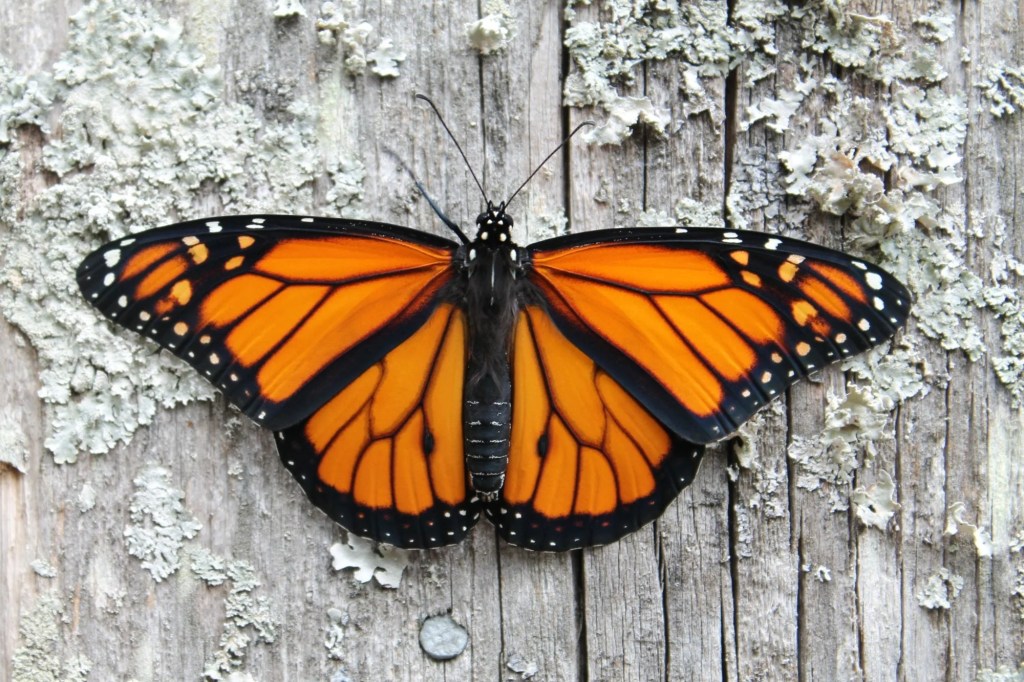
I was reading Thomas Mann’s “Doctor Faustus” when I came across a fact one of his characters shared about a beautiful large butterfly family, the most famous and beautiful of all butterfly families because of the intricate detailed patterns on their huge wings glowing with amber orange and how they are known to taste bad in the whole animal kingdom. It has been two weeks since I read that passage and I don’t know why I can’t stop thinking about this beautiful butterfly that tastes repulsive. So I read up on this fluttering emotion in the form of a butterfly.
They fly ever so slowly, almost like a sunset-hued linen candy wrapper (if one ever exists) being carried by the wind towards its direction – not resisting a single obstacle. They are slow because they don’t need to fly fast to survive their predators, they are not a desirable prey. They are merely a decoration in the natural world. As caterpillars they feed on milkweed plants and grow to carry that chemical that makes them oh so undesirable. I doubt they are as happy as they look in their purposeless existence. But how enjoyable to look at, especially for us humans who use the giddiness of butterflies in many of our descriptions and metaphors of newness, joy and spring.
They are called “Monarch Butterflies”, but their scientific name is “cardiac glycosides” because their bad taste can actually shock birds to death. So the birds know not to consume them. But sometimes, that eventual forgiving, generous and daring bird would take a bite and fall to its demise.
Forgiving because those butterflies didn’t choose to be cast out in a world that functions best in its eat or be eaten mentality, the bird forgives the repulsiveness and danger the butterfly offers.
Generous so that the bird may give this butterfly some of the integrity that it deserves in its exquisite existence: by snatching it within its beak, the bird gives the butterfly an out of the ordinary legendary fall.
Daring because what is one’s animalistic purpose if we have nothing to protect, even ourselves, from the perils of danger? That bird knows. So did the butterfly that flew slowly in front of that bird’s gaze, consciously offering it its’ life. Do you know what life is without risk? I thought I did. I thought it was comfortable but boring. But this Cardiac Glycoside large beautiful insect taught me otherwise.
Life has no purpose at all without the posed danger of being eaten alive. IN our case, by society, work, bills, political wars, judgemental people, religious fanatics. They are all doing us a favour in their undesirable existence.
Whenever that rare daring “bird” takes that leap and confronts the regular by acting irregularly to break a pattern, something so subtle happens that shakes the world and we learn so much more about sacrifice, possibilities and miracles than we thought we knew.
The exchange of life for death was a very conscious sacrifice that both insect and bird took. It is extremely hard for me to believe otherwise. I feel that they understand that when a pattern breaks, its whole becomes more complete: that slight planned imperfection makes the perfection obsolete. It takes an expert eye, or simply a faithful one, to notice that break and find beauty in its planned and deliberate flaw.
Beisan A. Alshafei
January 28th, 2019
This is the first piece I shared on instagram when I decided to share my writings and offer my writing and ghostwriting services. I am not very proud of it, but I love the prompt that prompted me to begin.

 Beisan's Burble