
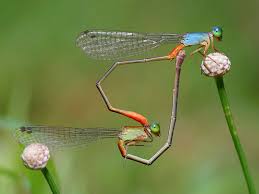
A couple of days ago, I learned that Damselflies form a shape of a heart when they mate. I started contemplating about the conventional shape of a heart <3. Why is it called after a bodily organ that does not look at all like the blood pumping muscle in our bodies? Why was it not called ‘Love’ or something else? It’s not as straightforward and natural as a circle, a square, a triangle, or a rectangle. It has a dent in the middle and requires some knack to make it look pretty.
I did a super quick online browse about when Man decided to designate this eye-soothing shape to a symbol of love. Some say it originated in the Greek colony of Cyrene where a giant fennel called “Silphium” grew; its’ healing medicinal properties protected the people of this colony from sickness and so, I suppose their hearts beat longer due to this heart-shaped plant. I started imagining colonies of people plucking it from its’ roots saying, “Good for the heart!” Consequentially, the name for the shape and its use caught on.
Since the 1250’s, intellectuals challenged each other with different theories of the history and origin of the heart-shape. Scholars found it in ancient texts, anatomical drawings and medieval paintings. Some say that it is shaped like this because it represents sexual organs or body parts. Others suppose that it was inspired by water lilies, I imagine it is because of how their leaves float open on the surface of the water vulnerably. And certainly, love is all about vulnerability.
In most of these ancient findings, the heart as a representation of Love was always shaped upside down! Only in the 19th century when marketing became a thing, and someone somewhere said that the heart looked better right-side-up, that the shape is what it is today: ❤
Why didn’t anyone think of Damselflies? Didn’t a someone, somewhere, witness the mating of these two damselflies and designate the heart-shape to this act of necessary carnal love between them? If that someone existed, why wouldn’t anyone stick to the glory of this someone’s discovery as the sole meaning for why this ideograph of love is shaped as such: ❤ ? How come a sole giant fennel, or the smooth sailing of a water lily leaf, got the credit?
When a male damselfly wants to mate, he performs quite a spectacle! He dances, zipping along the water, showing off his wings. The more the male damselfly has traveled in search for females, the more he has danced, the better he is at it, the more he has seen, the more he knows and the more colorful his wings are. Science confirms that the female watching this performance knows this, it’s how she picks her male.
Females observe this solo tango attentively, a movement driven by a natural animalistic need and scientifically explained, yet so inexplicably humane with patient romance and a calculated act of luring. Let’s imagine one of them; there she is, her eyes lingering on the best dancer, her heart beats with his in synchronicity until he feels it. For how else does he go to her specifically?
An interested male would zip some more along the water for his female that has by now attracted him, then approaches her and clasps her by her neck to carry her with him.
Together the damselflies dance in tandem. If she likes him, (which in human world we know as, if he took her breath away) she will communicate her consent by lifting her abdomen to mate, and make the shape of a heart. These two damselflies form that universal man-made ideography of love, through a romantic soulful approach that has been accredited to human competence alone. But lo and behold! Even in scientific textbooks about flies, the mysterious loving heart-shape finds its’ way in.
It is a communicative ideography that exists beyond our smart phones, shared with us by this species of beautiful flies, which are almost always mistaken for dragonflies. While man is busy changing the position of this ideograph from upside down to right side up: an ideograph that apparently existed in nature before he beat his chest with his fist and said, “I fashioned it!” no one had time to watch those flies make love in a shape of a heart.
There is a universal knowledge that is shared in the cells of every human being. We just need to look at nature and its’ creatures to remember this permanent connection; the constant reminder of it makes us more humble and less superior beings. We are fools when we think we created and achieved alone. All the biological facts cannot sum up to the universe’s funny way of telling us: “THEY WERE HERE BEFORE YOU, YOU ARE INSPIRED BY THEM.” With and through watching nature, we share ways of loving, we share the matter that creates our needs, we share fears and anxieties, we share defense mechanisms, we share the fight and flight reactions, and we even share emoticons and ideographs as conventional as heart-shapes.
Beisan A. Alshafei
February 13th, 2019

 Beisan's Burble